Noise Between Floors
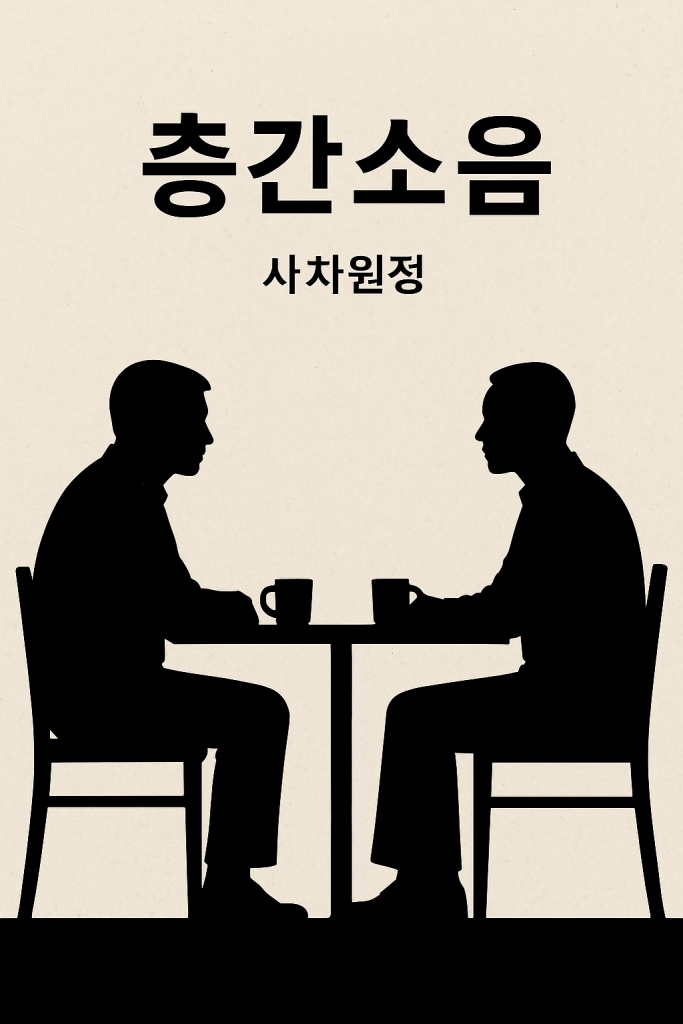
Title: Noise Between Floors
11:10 a.m. First-floor meeting room. He set down two cups of coffee. His movements were a little too precise, as if choreographed. I sat across from him and picked up the cup carefully. The coffee was hot, but it had no scent—like the air in this room.
“Anything unusual lately?” asked Lawrence, my team lead. He sounded calm, but I could tell he already knew.
I hesitated. “Is this… about the paper I passed around yesterday?”
He nodded. “What was your intention?”
I spoke carefully, but openly. Like laying down bricks, I built the story step by step. I explained how, just before year-end evaluations, the director had commented that our office was too noisy. Then in my one-on-one incentive meeting, I was told my score dropped because I “talk too much.”
A few days later, after speaking quietly to a colleague, Joseph, another manager, suddenly told me—sternly—to keep it down.
Was that fair? I wasn’t sure. So I circulated a short, anonymous survey to others who share our office. The responses were clear: I wasn’t disturbing anyone. Some even said I made the atmosphere better.
It all pointed to one thing:
“Working near him has been… stifling. I think moving desks might help.”
Lawrence nodded. “If it’s not about incentives, that’s good. But let’s be real—when you hand someone a paper to fill out, they’re not going to say anything bad.” His tone was sharp, a little cynical.
I replied, “I told them they didn’t have to fill it out. Only those who wanted to did.”
Lawrence admitted Joseph had handled things poorly, but said he probably interpreted the director’s comment as a kind of rule—and when that rule was broken, he reacted out of discomfort.
I said nothing.
“I don’t think he understands me at all,” I began. “We’ve been in the same office for ten years. Most people eventually get me, but he doesn’t. I think he sees me as less than him.”
I laid out the details. Once, when his documents went missing, he went through mine without asking. Another time, a vendor submitted the wrong inspection paperwork, and without checking, he blamed me. It wasn’t even my mistake.
He’s never trusted me. And honestly, I don’t think he ever will.
Right now, I’m responsible for both production scheduling and quality document compliance. Officially, I’m on the production team, but I report to two managers. I get evaluated—performance and behavior—by both.
They say it’s a 50/50 split. But really, it feels like being judged twice.
Lawrence nodded. “I know you’re juggling both roles. We can revisit that later. But for now, it is what it is.”
“Then,” I said, “all the time I put into scheduling—working late, adjusting shifts—none of that matters when it’s time for evaluation. They only look at the next week’s output reports. I’m the one organizing and managing all the quality paperwork, but if a single signature is missing, I’m the one who gets called out. It’s starting to feel pointless.”
He tilted his head. “What’s the workload split?”
“Seventy-thirty. Quality’s seventy.”
“Then bump production up to fifty.”
I repeated it silently. I’m already drowning… now I need to take on more?
Out loud: “How would that help? Even if I do more, the evaluations won’t change.”
“You shouldn’t be doing less. Always look to do more.”
I kept my voice calm. “I’ve been working hard on improving my attitude. But it’s like living below a noisy neighbor. No matter how softly I walk, they still complain.”
Lawrence nodded. “Results matter. And you know, some people are just born a certain way. I’m a pessimist. I think attitude is… innate. It affects how people see you.”
That froze me.
Innate.
Was he implying something’s wrong with me?
He continued. “It’s not just about noise. There’s bias among the managers. Some like you. Some don’t. Your score reflects that mix. It’s not just one incident.”
That word—bias—stuck in my head. Who was he talking about?
“So no matter how hard I work, I’m stuck in the middle because of bias… and something I was born with?”
“You’ll have to work harder than others,” Lawrence said.
He then talked at length about his own past. Poor evaluations. No explanation. A new job. A better outcome—eventually. His takeaway: just keep going.
I stayed quiet.
“So basically,” I said, “if I’m lucky, someone might eventually see me for who I am?”
“Yes,” he said. “You never know. Someone might.”
He brought up Joseph again. “He’s still new as a team leader. There are things he’s missing. I could talk to him, but… maybe it’s better if you handle it yourself.”
I thought about it. If I confront him, I’ll come off as arrogant. And Lawrence clearly isn’t going to intervene.
“Should I really be the one to do that?” I asked.
“Yes,” he said.
Of course.
“Even if I talk to him, I doubt he’ll change. Let’s forget about the seat change. If I ask again, people will just think I’m being difficult. I’ll stay where I am. Nothing’s going to change anyway.”
The meeting ended.
At lunch, I sat with a few coworkers at a café. Emily, from another department, said something. Apparently, after I left work yesterday, Jennifer, one of the managers, had come by asking about the paper. She sighed, then walked away.
I told them Lawrence had called me in that morning. We talked for nearly an hour.
They nodded. Word had already spread. People assumed I passed around the paper because I was angry about incentives. Director Daniel, Jennifer, and Lawrence had apparently been scrambling since yesterday.
Just then, the café door opened.
Lawrence, Jennifer, and Director Daniel walked in.
Their eyes brushed past me.
Jennifer’s look was cold—like glass.
I took a sip of coffee.
Still no scent.
Maybe it wasn’t the coffee. Maybe it was the air back at the office. Maybe it was something else entirely.
※ This story is a work of creative nonfiction, inspired by the author’s personal experience.
Names, characters, and situations have been fictionalized for narrative clarity.
Any resemblance to real persons or organizations is purely coincidental and not intended to defame or harm.
 4Dwonjung Music-사차원정
댓글 남기기